Showing posts with label Ollantaytambo. Show all posts

Monday, 2 June 2014

Taking the PeruRail train from Ollantaytambo to Machu Picchu

As mentioned in our previous article, to reach Machu Picchu, visitors have to take the train in Ollantaytambo. The whole day PeruRail offers transport that makes the journey in both directions between Ollantaytambo and Aguas Calientes, the small village in the valley next to Machu Picchu. You have to make reservations in advance and need to show your passport. When travelling directly from Cusco, there is a bus connection. The train journey takes about two hours.

PeruRail is offering different service levels. The cheapest option available is the Expedition Train. It offers customers a good travelling experience and you have nice views on the mountains and river. The train is less comfortable as the Vistadome train which has larger windows. We originally booked on the Vistadome but received tickets for the Expedition Train. Luckily we were pleased with the trip.

The most luxurious option is the Hiram Bingham Train awarded prices for the best train experience in the world. A journey to remember, a cozy environment with aperitif, gourmet dinner and up to perfect service. It is a train in the same class as the Orient Express. We considered booking but when we saw the prices, we were shocked. Prices go up to 750 dollar for a return train ticket. This is decadent if you know that government doctors in Peru only earn about 300 dollars a month. We were happy with the Expedition train at 80 dollars.

Zoals vermeld in ons vorig artikel nemen bijna alle bezoekers de trein in Ollantaytambo om naar Machu Picchu te reizen. PeruRail biedt de ganse dag transport aan tussen Ollantaytambo en Aguas Calientes, een dorp aan de voet van de Machu Picchu berg. Je moet wel op voorhand reserveren en je paspoort bij hebben. Als je rechtstreeks uit Cusco reist, is er ook een busverbinding beschikbaar. De treinreis duurt ongeveer 2 uren.

PeruRail biedt verschillende kwaliteitstreinen aan. Het goedkoopste alternatief is de Expeditietrein. Dit is een goede reiservaring met prachtig zicht over de bergen en rivier. De trein is minder comfortabel als de Vistadome trein die tevens grotere vensters bevat. Wij boekten op de Vistadome maar door een vergissing kregen we tickets voor de Expeditietrein. Gelukkig waren we toch tevreden over de rit. 

De meest luxueuze optie is de Hiram Bingham trein die reeds prijzen kreeg voor de beste treinrit ervaring ter wereld. Eén rit uit duizend, een gezellige sfeer met aperitiefje, een gastronomisch diner en bediening die streeft naar perfectie. Het is een trein in dezelfde klasse als de Oriënt Express. Wij hebben even overwogen met deze trein te reizen maar toen we de prijzen zagen waren we gechoqueerd. Voor een heen en terug kaartje kan je tot 750 dollar neertellen. Dit is decadent als je weet dat overheidsdokters slecht 300 dollar per maand verdienen in Peru. We waren wel tevreden met ons 80 dollar ticket voor de Expeditie Trein. 
 
Expediation Train to Machu Picchu

Expediation Train to Machu Picchu

Expediation Train to Machu Picchu

Expediation Train to Machu Picchu

Expediation Train to Machu Picchu

Expediation Train to Machu Picchu

Expediation Train to Machu Picchu

Expediation Train to Machu Picchu

Expediation Train to Machu Picchu

Expediation Train to Machu Picchu

Expediation Train to Machu Picchu

Expediation Train to Machu Picchu

Expediation Train to Machu Picchu

Previous Ollantaytambo article: Ollantaytambo defense fortress saves Machu Picchu from the conquistadors

Previous Train article: Graffiti at the train station of Villefranche-Sur-Mer

Return to main page

Saturday, 31 May 2014

Ollantaytambo defense fortress saves Machu Picchu from the conquistadors

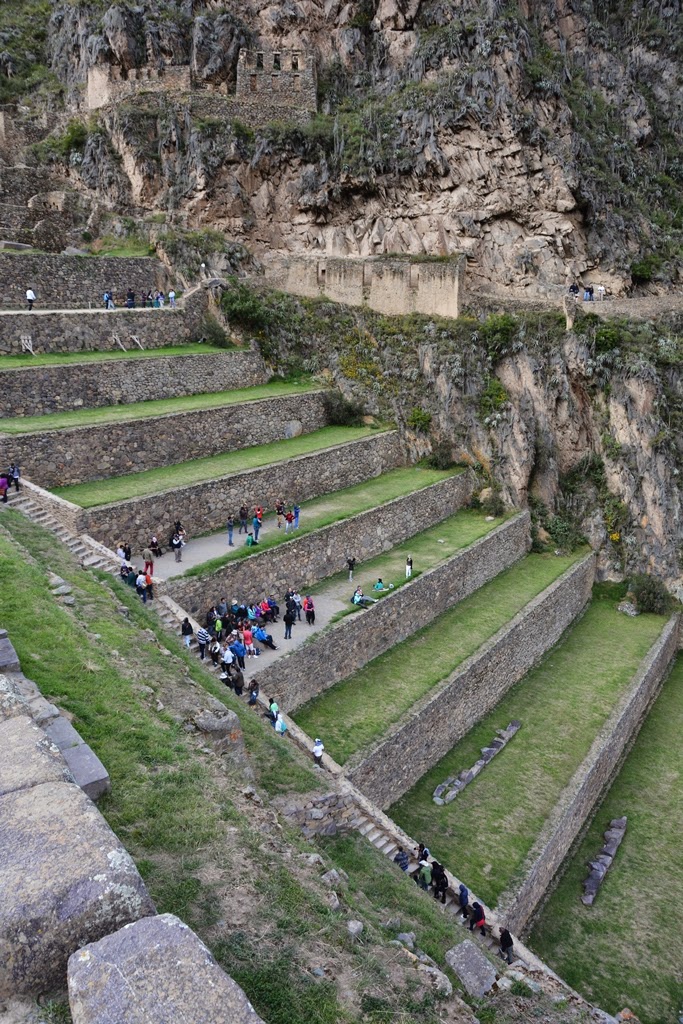
What an amazing Inca site Ollantaytambo has. The terraces had an agricultural function like everywhere in Peru. This major complex had mainly a religious function and has never been completed. This is visible at the back of the mountain where we still see a handmade ramp to pull large rocks up the mountain.

We liked this site so much because of its beautiful ruins and hiking trails. It is just fantastic to look down on the terraces and walk on the narrow dirt paths. In the lower part of the Inca complex there are still a few temples with streaming water.

Due to the steep terraces and being surrounded by mountains, this Inca site had a strategic defense location. The Spanish conquistadors had heard of the Inca city of Machu Picchu and were going to destroy it like all the others. To reach Machu Picchu, just like today, you have to pass via Ollantaytambo.

The last Inca King Manco blocked the access road to Machu Picchu via this fortress, it has hidden for the invaders. They had two choices, defeat the Inca's at Ollantaytambo by taking the fortress or continue their search for Machu Picchu going east or west alongside Ollantaytambo. After a long fight and several defeats this is what they did.

Continuing alongside the Urubamba River they could not see Machu Picchu hidden behind the trees of the tropical forest in the mountains. Making their way to the right, through the jungle, most conquistadors got sick and died. Their biggest weakness was getting ill from the altitude. A whole Spanish regiment searched 34 years for Machu Picchu and couldn't find it. Eventually Ollantaytambo fell but today’s most famous Inca city Machu Picchu was never discovered by the colonists.

Wat een verbluffend Inka complex vinden we hier in Ollantaytambo. De terrassen hebben een landbouwfunctie net zoals overal in Peru. Oorspronkelijk was dit een religieuze plaats maar deze werd nooit volledig afgewerkt. Dit is zichtbaar aan de achterkant van de berg waar nog een man gemaakte helling ligt voor het naar boven trekken van bouwstenen.

Deze site trok ons zeer sterk aan vanwege de mooie ruïnes en wandelpaden. Het is gewoon fantastisch het complex beneden te zien van op een smal aarde pad. In het lager gelegen gedeelte van het complex staan nog enkele tempels met stromend water.

Door de steile terrassen omringt door bergen was deze Inka site een strategische verdedigingsplaats. De Spaanse veroveraars hadden gehoord over Machu Picchu en gingen ook deze stad vernietigen zoals alle andere. Net zoals vandaag, moest men via Ollantaytambo passeren vooraleer Machu Picchu te bereiken.

De laatste Inka koning Manco blokkeerde de weg naar Machu Picchu met deze vestiging, de stad was verborgen voor de invallers. Ze hadden twee keuzes om Machu Picchu te bereiken, via de linker en rechter zijde van Ollantaytambo. Na een lang gevecht gingen ze inderdaad verder langs beide wegen. 

Hun weg makende via de Urubamba Rivier konden ze Machu Picchu niet zien dat verborgen lag in de bergen achter bomen van het tropische regenwoud. Langs rechts moest men door het oerwoud en de meeste Spanjaarden lieten het leven. Hun grote zwakte was hoogteziekte. Het Spaanse regiment zocht 34 jaar in het oerwoud en kon Machu Picchu niet vinden. Later viel Ollantaytambo toch onder de aanvallen maar de meest beroemde Inka Site ter wereld, Machu Picchu werd nooit gevonden door de kolonisten. 
 
Ollantaytambo Inca Site

Ollantaytambo Inca Site

Ollantaytambo Inca Site

Ollantaytambo Inca Site

Ollantaytambo Inca Site

Ollantaytambo Inca Site

Ollantaytambo Inca Site

Ollantaytambo Inca Site

Ollantaytambo Inca Site

Ollantaytambo Inca Site

Ollantaytambo Inca Site

Ollantaytambo Inca Site

Ollantaytambo Inca Site

Ollantaytambo Inca Site

Ollantaytambo Inca Site

Ollantaytambo Inca Site

Previous Ollantaytambo article: Ollantaytambo town, one of the oldest cities of South America

Previous Temple article: The Inca IntihuatanaTemple of Sacred Valley

Return to main page

Friday, 30 May 2014

Ollantaytambo town, one of the oldest cities of South America

This little village of Ollantaytambo, on a altitude of about 2.700 meters, was founded during the 15th century which makes it one of the oldest still existing cities of the South American continent. We were not expecting this since most of the houses are basic and primitive. It looks like time stood still and the community has not modernized.

The small cars are an attraction on its own and a large part of the inhabitants get their income from tourism. Why are tourists coming here? Certainly not for the local markets or shops, this is just a side business.

Ollantaytambo is in fact the main entrance for two of very famous Inca sites. The Inca fortress and temples of Ollantaytambo itself, which we are going to show in our next article and it is the access way to Machu Picchu, about 1,5 hours travelling from here. Almost all visitors going to Machu Picchu take the train in Ollantaytambo. That's is the reason why the hotels are always fully booked here.

Het kleine stadje Ollantaytambo, gelegen op een hoogte van ongeveer 2.700 meter, werd opgericht gedurende de 15de eeuw en is hiermee één van de oudste nog bevolkte steden van het Zuid-Amerikaanse continent. Dit hadden we niet verwacht daar de huizen heel basis en primitief zijn. Het lijkt alsof de tijd hier heeft stil gestaan en dat ontwikkeling en modernisering niet werd gestimuleerd.

De kleine auto's of soms zelfs autobrommers zijn een attractie op zich zelf en de stad lijkt hoofdzakelijk te leven van toerisme. Waarom komen bezoekers in feite hier heen? Zeker niet voor de lokale markt of winkeltjes, dat is slechts een bijeffect. 

De stad Ollantaytambo is de hoofdtoegang tot twee beroemde Inka sites. Het Inka fort en tempelcomplex van Ollantaytambo zelf en de toegangsweg naar Machu Picchu dat nog op 1,5 uur reizen van hier ligt. Bijna alle Machu Picchu bezoekers nemen de trein in Ollontaytambo. Dit is de reden waarom de hotels hier altijd volgeboekt zijn. 
 
Ollantaytambo Town

Ollantaytambo Town market

Ollantaytambo Town blind musician

Ollantaytambo Town

Ollantaytambo Town

Ollantaytambo Town

Ollantaytambo Town

Ollantaytambo Town

Ollantaytambo Town

Ollantaytambo Town

Ollantaytambo Town

Ollantaytambo Town

Ollantaytambo Town

Previous Ollantaytambo article: Alpaca Carpaccio at the Tunupa Restaurant, Ollantaytambo

Previous General Impressions article: General Impressions of Cusco, the old capital of the Inca’s

Return to main page

Wednesday, 28 May 2014

Alpaca Carpaccio at the Tunupa Restaurant, Ollantaytambo

For lunch we stopped at a marvelous restaurant from the Peruvian Tunupa chain. The farmhouse was surrounded by beautiful flower gardens. At the Urubamba River, there stood a few Llama's. Next to smaller tropical birds there were several parrots in the trees, some of them really approached you.

We were lucky to have a table outside on the terrace overlooking the garden. The food was served in the form of a cold and warm buffet. Being in Peru, we had to try the Alpaca Carpaccio. You could compare it with beef but a little dryer and stronger in taste, it had a touch of deer.

Overall the food was good and we enjoyed the company of two female travelers from Kuala Lumpur. How lucky can we be, we will be visiting Kuala Lumpur in October and already received a lot of inside information about the capital of Malaysia. During lunch, the girls admitted that eating is the Malaysian National Sport. Funny.

Voor het middageten stopten we aan een prachtig restaurant van de Peruviaanse keten Tunupa. Het landhuis was omringd door een mooie bloementuin. Aan de oever van de Urubamba Rivier stonden enkele Lama's te grazen. Naast de veel voorkomende kleine tropische vogels waren er verschillende papegaaien in de bomen, sommigen kwamen heel dichtbij.

We hadden geluk dat er een tafeltje op het terras met zicht over de tuin vrij was. Er werd een koud en warm buffet opgesteld. Nu we in Peru waren, moesten we wel de Carpaccio van Alpaca proeven. Je kan het een beetje vergelijken met rundvlees maar iets droger en sterker in smaak, het had wel iets weg van wild. 

In het algemeen was het eten lekker en we genoten van het gezelschap van twee dames uit Kuala Lumpur. Hoeveel geluk kunnen we hebben? In oktober gaan we naar Kuala Lumpur en hier kregen gewoon de beste lokale tips over de hoofdstad van Maleisië, recht van de bron. Tijdens de lunch vertelden de dames ons dat eten de Nationale Sport van Maleisië is. Hoe grappig. 
 
Tunupa Restaurant Ollantaytambo

Tunupa Restaurant Ollantaytambo flower garden

Tunupa Restaurant Ollantaytambo flower garden

Tunupa Restaurant Ollantaytambo

Tunupa Restaurant Ollantaytambo Urubamba River

Tunupa Restaurant Ollantaytambo Flowers

Tunupa Restaurant Ollantaytambo Flowers

Tunupa Restaurant Ollantaytambo cheers

Tunupa Restaurant Ollantaytambo llama

Tunupa Restaurant Ollantaytambo parrot

Tunupa Restaurant Ollantaytambo flowers

Tunupa Restaurant Ollantaytambo garden

Tunupa Restaurant Ollantaytambo arch

Tunupa Restaurant Ollantaytambo

Tunupa Restaurant Ollantaytambo

Previous Sacred Valley article: Awana Kancha keeps traditional craftsmanship alive

Previous Restaurant article: Peruvian Cuisine in restaurant El Mirador, Cusco

Return to main page